
Quick summary
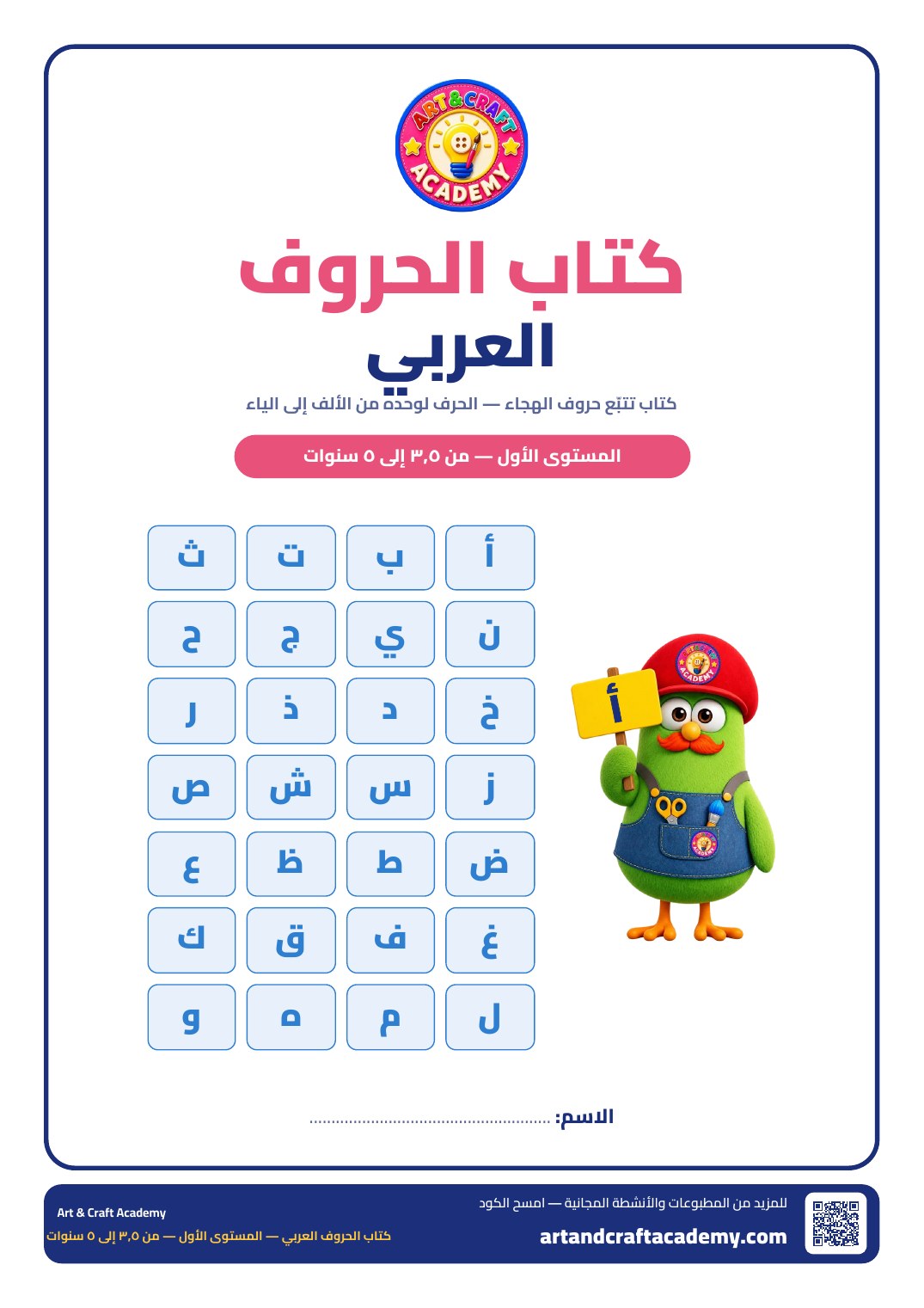
Arabic Letters, Level 1 is a free 35-page A4 PDF for children ages 3.5 to 5. Children meet 28 letters (each letter on its own). They trace it with a finger and then a pencil, write it, and look for pictures that start with it. Letters are grouped in families of similar shapes, so the hand repeats the same movement. The book is in Arabic; this page gives you the English guide you need. It includes a guide for parents and teachers, a progress page, and a certificate.
At a glance
- Ages 3.5–5 (Level 1 of the Arabic letters series)
- 35 pages · A4 PDF
- 28 letters, each letter on its own (letter shapes inside words come in Level 2)
- Free download, no sign-up
- Best laminated, with a wipe-clean marker
How does this book help your child?
The goal is not a perfect line on the first try. It is to recognize each letter’s shape and sound and to practice its writing path:
- Writing strengthens letter recognition: in a 6-week study of 76 preschoolers (about 3 to 6.5 years old), children who wrote letters improved more on a letter-recognition test than children who only looked at them.
- Shape families: grouping similar letters lets the hand repeat the same movement.
- Sound and picture links: finding pictures that start with the letter connects shape to sound.
- Short sessions: one or two letters at a time keeps practice calm.
Ages are approximate and every child has their own pace. If resistance lasts for weeks, check with a specialist.
What is inside the file?
- 28 letters (each on its own): trace with a finger, then a pencil, then write alone.
- Picture clues that start with each letter.
- Guide for parents and teachers (in Arabic), plus a progress page and a certificate.
Guide for parents and teachers: how to use the book
For parents who don’t read Arabic
- The 28 letter names, in the usual alphabet order: Alif, Baa, Taa, Thaa, Jeem, Haa, Khaa, Dal, Dhal, Raa, Zay, Seen, Sheen, Saad, Daad, Taa (emphatic), Dhaa, Ayn, Ghayn, Faa, Qaaf, Kaaf, Laam, Meem, Noon, Haa, Waw, Yaa.
- Arabic is written and read from right to left, so start on the right side of the page.
- A few sounds (such as Haa, Khaa, Ayn, Ghayn, and Qaaf) have no exact English equivalent. Listen to a native speaker or a pronunciation video before you teach them.
- The instructions inside the PDF are in Arabic. This page explains what you need to run each session.
Set up
- Print on A4 at 100% (Actual size), not “Fit to page”.
- Laminate the pages or use a clear sleeve, and use a dry-erase marker.
- Keep it calm: a small table, good light, no screens.
How to present
- Pick one or two letters per session; start with the letters of your child’s name.
- Say the letter name and sound; look at the pictures together.
- Finger first, then pencil or marker.
- If your child resists, stop without pressure and try again another day.
Five to ten minutes is plenty. If pencil grip stays very difficult for weeks, check with a specialist.
Next step: After Level 1, move on to Arabic Letters Level 2 (letter forms at the start, middle, and end of a word).
Frequently asked questions
What age is Level 1 for?
About 3.5 to 5 years old.
I don’t read Arabic. Can I still use it?
Yes. Use the letter names and the right-to-left tip on this page, and listen to a native speaker for the sounds. The PDF’s instructions are in Arabic.
Does it teach letter shapes inside words?
No. Level 1 teaches each letter on its own. Level 2 covers shapes at the start, middle, and end of a word.
Is it free?
Yes, free for personal and classroom use with no sign-up. Please share the link to this page, not the file, and do not sell or re-upload it.
License and terms of use
- Allowed: print and laminate for personal use with your own children, and in the classroom or learning sessions.
- Allowed: share the link to this page with others.
- Not allowed: selling the file or any part of it, uploading it to another website, channel, group or store, or presenting it as someone else’s work.
- Commercial use (books or products for sale) requires written permission.
© Art & Craft Academy. All rights reserved. For questions, use our contact page.
Printed and laminated version: coming soon.
Sources
Ages are approximate. Sources reviewed October 2026.