
Quick summary
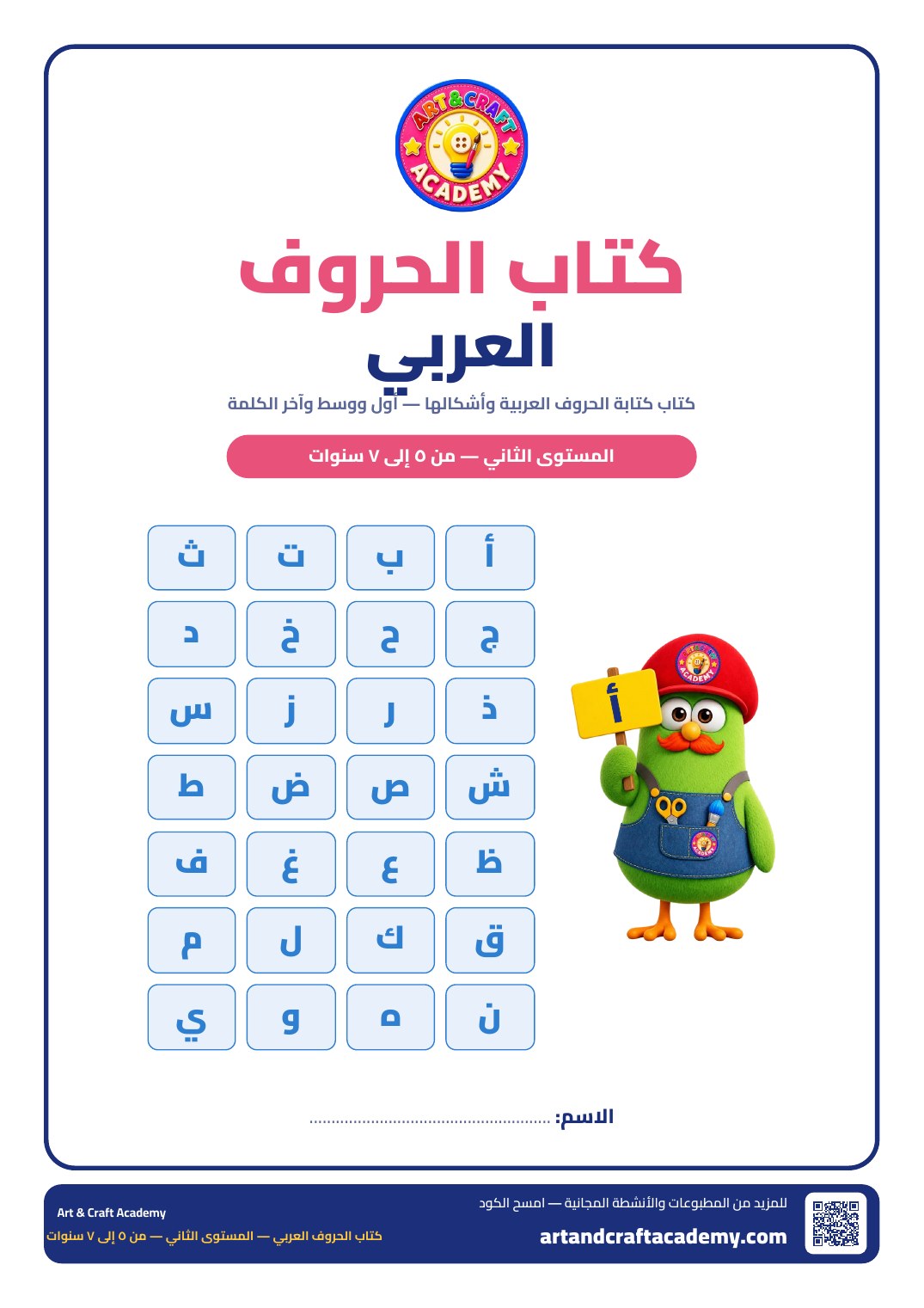
Arabic Letters, Level 2 is a free 35-page A4 PDF for children ages 5 to 7 who know the letters on their own and are ready for the next step. Children learn 28 letters and each letter’s forms at the start, middle, and end of a word: they trace with a finger, copy the model, write on the dots and then alone, and find the letter among others. The book is in Arabic; this page gives you the English guide. It includes a guide for parents and teachers and a certificate.
At a glance
- Ages 5–7 (Level 2 of the Arabic letters series)
- 35 pages · A4 PDF
- 28 letters with their forms as needed: alone, at the start, in the middle, and at the end
- Free download, no sign-up
- Best laminated, with a wipe-clean marker
How does this book help your child?
The goal is to move from the letter on its own to the letter as it appears inside a word:
- Letters change shape in words: studies suggest most Arabic letters change form by position in the word, which is one reason Arabic writing is complex. In one study of Arab children, first graders appeared to read words letter by letter, which supports practicing each form separately.
- Writing helps recognition: in a 6-week study of 76 preschoolers (about 3 to 6.5 years old), children who wrote letters improved more on a letter-recognition test than children who only looked at them.
- Step by step: trace, copy the model, write on dots, then write alone.
- Find the letter: spotting it among other letters builds recognition.
Ages are approximate. Not every letter has four different forms: some letters keep nearly the same shape in every position.
What is inside the file?
- 28 letters with their forms as needed (alone, start, middle, end).
- Practice: finger tracing, copying a model, writing on dots, writing alone, and finding the letter.
- Guide for parents and teachers (in Arabic) and a certificate.
Guide for parents and teachers: how to use the book
For parents who don’t read Arabic
- The 28 letter names, in the usual alphabet order: Alif, Baa, Taa, Thaa, Jeem, Haa, Khaa, Dal, Dhal, Raa, Zay, Seen, Sheen, Saad, Daad, Taa (emphatic), Dhaa, Ayn, Ghayn, Faa, Qaaf, Kaaf, Laam, Meem, Noon, Haa, Waw, Yaa.
- Arabic is written and read from right to left, so start on the right side of the page.
- A few sounds (such as Haa, Khaa, Ayn, Ghayn, and Qaaf) have no exact English equivalent. Listen to a native speaker or a pronunciation video before you teach them.
- The instructions inside the PDF are in Arabic. This page explains what you need to run each session.
Good to know
- Six letters (Alif, Dal, Dhal, Raa, Zay, Waw) do not connect to the letter after them, so the next letter keeps its own “start” shape.
- Start with letters in your child’s name and follow the book’s order.
Set up
- Print on A4 at 100% (Actual size), not “Fit to page”.
- Laminate the pages or use a clear sleeve, and use a dry-erase marker.
- Keep it calm: a small table, good light, no screens.
How to present
- One or two letters per session.
- Finger first, then copy the model, then the dots, then write alone.
- Stop without pressure if your child is tired.
Five to ten minutes is plenty. If resistance lasts for weeks, check with a specialist.
Next step: After Level 2, move on to Arabic Letters Level 3 (short vowel marks and reading words).
Frequently asked questions
What age is Level 2 for?
About 5 to 7 years old, after your child knows the letters on their own (Level 1).
I don’t read Arabic. Can I still use it?
Yes, with this page’s guide and a native speaker or audio for the sounds. The PDF’s instructions are in Arabic.
Do all letters have four forms?
No. Many letters change shape by position, but some keep nearly the same shape, and some do not connect to the next letter.
Is it free?
Yes, free for personal and classroom use with no sign-up. Please share the link to this page, not the file, and do not sell or re-upload it.
License and terms of use
- Allowed: print and laminate for personal use with your own children, and in the classroom or learning sessions.
- Allowed: share the link to this page with others.
- Not allowed: selling the file or any part of it, uploading it to another website, channel, group or store, or presenting it as someone else’s work.
- Commercial use (books or products for sale) requires written permission.
© Art & Craft Academy. All rights reserved. For questions, use our contact page.
Printed and laminated version: coming soon.
Sources
- Asaad & Eviatar (2013) — Arabic letter shapes by position in the word and reading (University of Haifa)
- Zemlock, Vinci-Booher & James (2018) — handwriting and letter recognition in preschool children (Indiana University)
Ages are approximate. Sources reviewed October 2026.